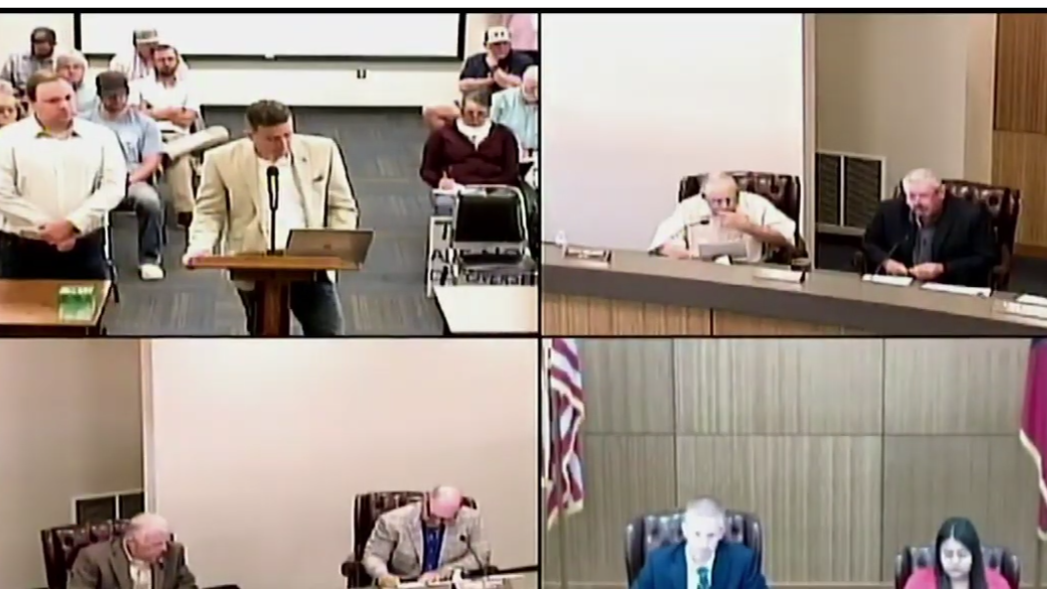
Today, I watched the Tom Green County Commissioners Court discussion with representatives from Cipher Digital regarding a potential data center development along Highway 67.

Given the conversations taking place across our community around data centers, water, power, property rights and growth, I expected difficult questions.
There were plenty of them.
But as I watched the discussion unfold, something else stood out to me: dialogue.
Cipher representatives spent a significant amount of time answering questions from commissioners about water usage, construction traffic, electrical demand, roads, housing, emergency services, groundwater, noise, lighting, property values, taxes and the potential impact on nearby residents.
In several cases, Cipher representatives acknowledged that some details have not yet been finalized and committed to bringing additional information back to the court and community.
I actually think that matters.
When projects of this size are being discussed, communities should be skeptical of easy answers. There are legitimate questions that require engineering studies, traffic studies, final designs and actual agreements before anyone can know the answers with certainty.
What matters is whether those questions are allowed to be asked — and whether the people proposing the project are willing to keep answering them.
Some important commitments were discussed
Cipher said the proposed facility would use air-cooled chillers and a closed-loop cooling system. Representatives said approximately two million gallons would be required for the initial fill and that water would be brought in rather than relying on local potable water for cooling.
Construction water became a significant topic as well.
Commissioners pushed for more information about how much water construction could require and where that water would come from. Cipher did not yet have a total construction-water estimate, but representatives said they would not use potable water for construction or cooling and expressed a willingness to put that commitment in writing.
That distinction matters in West Texas.
The discussion also went well beyond water.
Commissioners raised concerns about traffic on City Farm Road and Highway 67, the effect of potentially more than 1,000 construction workers coming into the area, pressure on hotels and housing, impacts on neighboring properties, volunteer fire departments and what happens to the property someday if the technology or facility becomes obsolete.
As the conversation continued, I noticed an important theme developing:
What can be put in writing?
That may ultimately be one of the most important questions surrounding large developments like this.
Ideas discussed included road-use agreements, community-benefit commitments, support for volunteer fire departments, a local community liaison, construction and traffic mitigation, decommissioning requirements and protections for surrounding property owners.
One particularly interesting discussion involved property values.
Members of the public suggested creating some form of protection for nearby property owners if the development negatively affects their ability to sell their property. Cipher representatives indicated they were open to exploring the idea.
There are obviously many details that would have to be worked out before something like that could become meaningful, but I thought it was noteworthy that the idea became part of the conversation rather than simply being dismissed.
Transparency matters
Another thing that stood out while watching the meeting was the willingness of people participating in public comment to challenge what they were hearing.
Questions were raised about a previous nondisclosure agreement, groundwater, the scale of the proposed development and statements made during the presentation.
Those challenges became part of the discussion.
Cipher also offered to allow Tom Green County officials to visit communities where the company already operates and speak directly with local officials — without Cipher representatives present — about their experiences with the company.
I hope that kind of due diligence happens.
Don't just listen to the presentation.
Go look.
Talk to the neighbors.
Talk to county officials.
Talk to emergency responders.
Ask what the developer promised before construction and then ask what actually happened afterward.
This is what the process should look like
I have been open about the fact that I believe responsible data center development can bring opportunities to our region.
But being open to development does not mean asking fewer questions.
It should mean asking more.
Large infrastructure projects can bring investment, construction activity, tax revenue and jobs. They can also create legitimate challenges involving infrastructure, housing, traffic, water, power and the people who already live nearby.
Both things can be true.
That's why I came away from watching today's discussion encouraged by the process.
The commissioners did not simply accept what they were told. They challenged the company repeatedly and made it clear that their responsibility is first to the people who already call Tom Green County home.
At the same time, they allowed the company to answer.
Members of the public challenged those answers.
And when some details weren't yet available, those became questions to carry into the next conversation.
No one should mistake dialogue for approval.
Talking to a developer does not mean supporting a project. Asking questions does not mean opposing one. And listening to someone with whom we disagree does not mean surrendering our own position.
It means we're doing the work.
There will almost certainly be more discussion about this project. Cipher indicated a willingness to participate in a community town hall, and commissioners discussed the possibility of holding a future meeting in the evening so more working residents can participate.
I hope that happens.
And I hope the next conversation goes even deeper.
Bring the conceptual drawings.
Bring the traffic analysis.
Bring the construction-water estimates.
Bring the proposed setbacks.
Bring the infrastructure plans.
And perhaps most importantly, start turning verbal commitments into written ones that the community can evaluate.
We don't have to decide whether every major development is entirely good or entirely bad before we're willing to sit across the table from one another.
Sometimes the most productive thing a community can do is ask hard questions, listen carefully to the answers, document the commitments and then keep asking questions.
From what I watched today, I think Tom Green County did that.