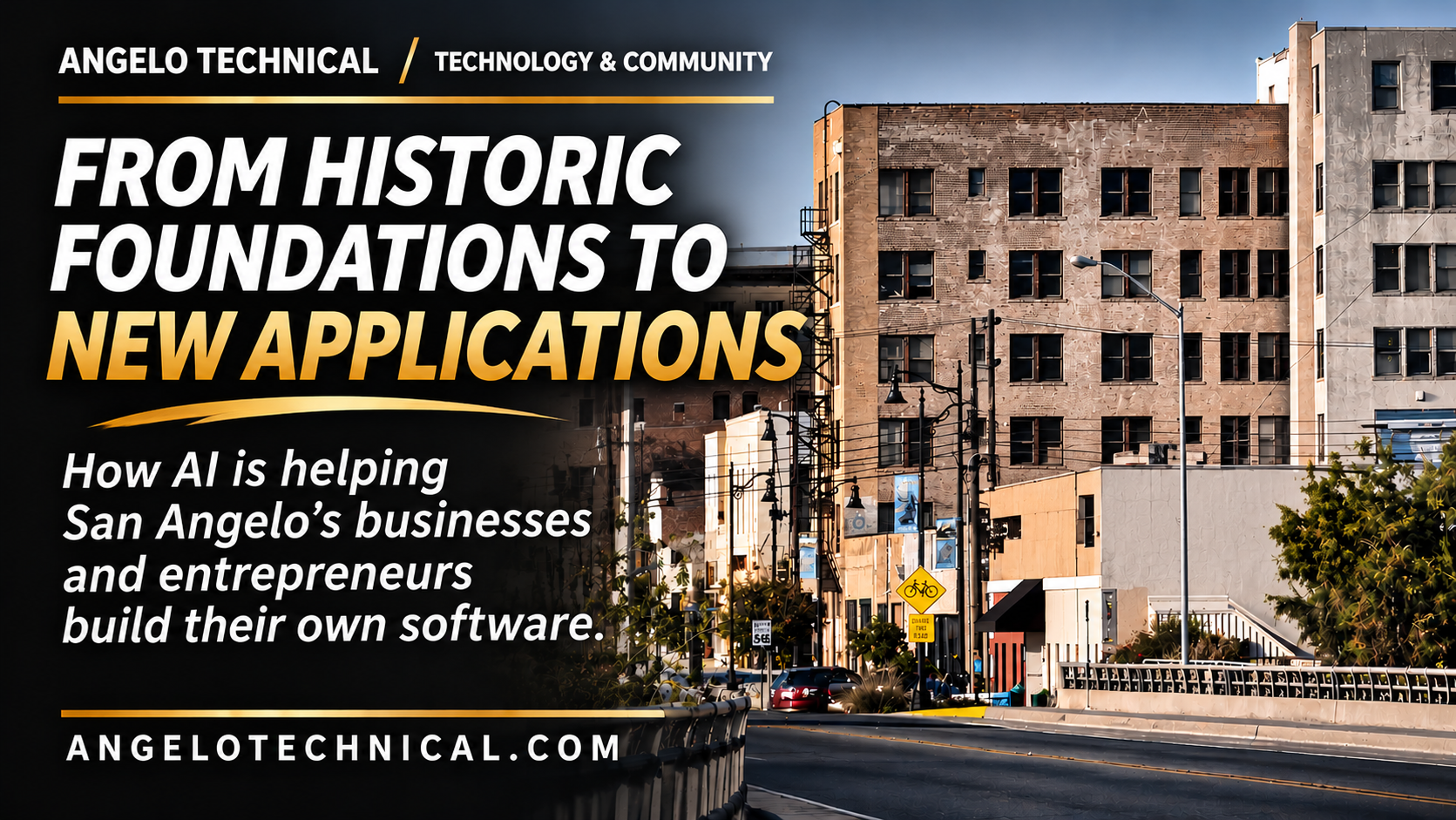
Take a drive through downtown San Angelo and you'll see reminders of generations of people who built businesses, pursued ideas, and helped shape the community we know today.
The buildings may be decades old, but the entrepreneurial spirit that built them is still very much alive. What's changing are the tools available to those who want to create something new.
Over the past several months, through my interactions with business owners, entrepreneurs, and technology professionals here in San Angelo, I've noticed something interesting. People who have never considered themselves software developers are beginning to build their own software.
They are creating applications, building websites, automating business processes, and developing tools to solve problems they encounter in their everyday work.
And many of them have never formally learned a programming language.
What is the most popular programming language in 2026? English.
Artificial intelligence is changing not only how software is developed but also who gets to participate in its creation.
From Consumers to Creators
For decades, if a small business owner had an idea for a software application, their options were relatively limited. They could purchase an existing product, hire a software developer, or invest considerable time learning how to write code themselves.
Today, there is another option.
Someone can sit down at a computer and describe what they want to build in plain English. They can explain what problem they are trying to solve, how they want an application to function, and what they want it to look like.
AI can help translate those ideas into working software.
What makes this particularly interesting is that the people closest to a problem are often the people best positioned to envision its solution. Historically, they may not have possessed the technical skills or financial resources to build it.
That barrier is becoming considerably smaller.
It's Happening Here in San Angelo
We often associate technological innovation with places like Silicon Valley, Austin, or other major metropolitan areas. But what I am seeing through my conversations here in San Angelo suggests that this transformation is not limited to those communities.
Local entrepreneurs and business professionals are discovering these capabilities for themselves. They are experimenting with AI, exploring what they can build, and beginning to recognize opportunities within their own businesses.
That excites me.
A restaurant owner, a real estate professional, a local retailer, or someone operating a small service business may have an idea that improves how they operate. They no longer necessarily need a substantial technology budget to begin exploring that idea.
For a community like San Angelo, that represents a meaningful opportunity.
Innovation doesn't always require attracting a large technology company. Sometimes it begins by empowering the people and businesses that are already here.
Does This Mean We No Longer Need Software Developers?
Absolutely not.
There is a considerable difference between building an application that appears to work and engineering software that is secure, reliable, scalable, and maintainable.
Coming from a background in information technology and cybersecurity, I recognize the risks associated with making software development more accessible. Security, privacy, data protection, and responsible engineering practices remain important, regardless of who or what generates the code.
But those concerns should not discourage people from exploring what is possible.
Instead, they should encourage us to educate and equip this new generation of creators.
Professional software developers will continue to play an important role. What is changing is the number of people who can participate in the process of turning an idea into something tangible.
The Democratization of Software Development
Think about what digital photography did for photography or what platforms like YouTube did for video production and broadcasting.
Neither eliminated the need for professionals. Both dramatically expanded the number of people who could participate.
AI is doing something similar for software development.
We are entering a period where creativity, curiosity, problem-solving, and knowledge of a particular business or industry can become powerful starting points for building technology.
Knowing how to articulate an idea, ask the right questions, evaluate results, and refine a solution is becoming increasingly valuable.
The ability to create software is no longer reserved exclusively for those who know how to write code.
Building on Historic Foundations
San Angelo was built by people who saw opportunities and had the ambition to pursue them. Today's entrepreneurs are inheriting that same spirit, but with an entirely new set of tools at their disposal.
The generations before us built storefronts, established businesses, and developed the physical infrastructure that allowed our community to grow. Today's generation has an opportunity to build upon those foundations in ways that previous generations could hardly have imagined.
There is something remarkable about the idea that someone sitting inside one of our historic downtown buildings could be developing a software application using some of the most advanced technology available today.
Innovation doesn't require us to abandon our history or identity. It allows us to build upon them.
What Will You Build?
One of the things I look forward to over the next few years is seeing what people right here in San Angelo create with these tools.
Some will build applications for their own businesses. Others may develop products that become businesses themselves. Some will simply build something because they are curious and want to see if they can.
Not every idea needs to become a startup. Sometimes building something that saves you an hour each week or solves a frustrating problem is an accomplishment worth celebrating.
We have an opportunity as a community to encourage this kind of experimentation, share what we learn, and help one another understand both the capabilities and responsibilities that come with these technologies.
If you have ever had an idea for an application but dismissed it because you didn't know how to code, perhaps it's time to revisit that idea.
In 2026, it seems everyone is becoming a coder, and the most common programming language might just be English.
Go make cool stuff!
Gabriel Menchaca | Angelo Technical
AngeloTechnical.com