Note: Originally posted to https://www.conchovalleytech.org/blogs/inside-sapd-s-artic-a-look-at-the-technology-watching-over-san-angelo
In a time when concerns about government surveillance and personal privacy seem to be everywhere, cameras on street corners, drones overhead, and automated license plate readers can understandably raise questions.
Who is watching? What information is being collected? How long is it stored? And perhaps most importantly, who is watching those who are watching us?
These are legitimate questions, and as someone who works in technology and cybersecurity, I believe they deserve thoughtful answers.
But I also believe that understanding how technology is actually being used is an important part of that conversation.
Recently, through my involvement with the Concho Valley Technology Alliance (CVTA), I had the opportunity to help arrange a visit to the San Angelo Police Department's Aviation & Real-Time Information Center, better known as ARTIC.
What began as a conversation with Assistant Chief Adam Scott at a community town hall meeting eventually became an invitation for CVTA representatives to see firsthand how the department uses drones, cameras, and other technologies to support law enforcement.
Fellow CVTA board member Britany Hernandez and I attended the tour on October 8.
What follows is my personal account of that visit, including the technology we observed, the questions we asked, and my own reflections on the balance between public safety, privacy, and accountability.
An Invitation That Started With a Conversation
The opportunity began during a recent City of San Angelo town hall meeting.
While attending the meeting, I introduced myself to Assistant Chief of Police Adam Scott and shared a little about my involvement with the Concho Valley Technology Alliance.
Our conversation eventually turned toward technology, specifically the department's use of Flock cameras and drones.
As a drone operator myself, the subject immediately caught my attention.
We exchanged perspectives on the technology, and Assistant Chief Scott mentioned that he could arrange a tour of the department's ARTIC operation.
We exchanged contact information and eventually went our separate ways to speak with other attendees.
Some time later, I received a telephone call from SAPD Sergeant Welch, extending an invitation for me and other CVTA representatives to visit the facility.
Needless to say, we accepted.
Behind an Unassuming Exterior
On October 8, Britany and I arrived at the ARTIC facility.
From the outside, there was little to suggest what was happening within.
The building was unassuming and undecorated. There was no prominent signage announcing that it housed a sophisticated police technology operation.
Officer Welch greeted us and escorted us inside.
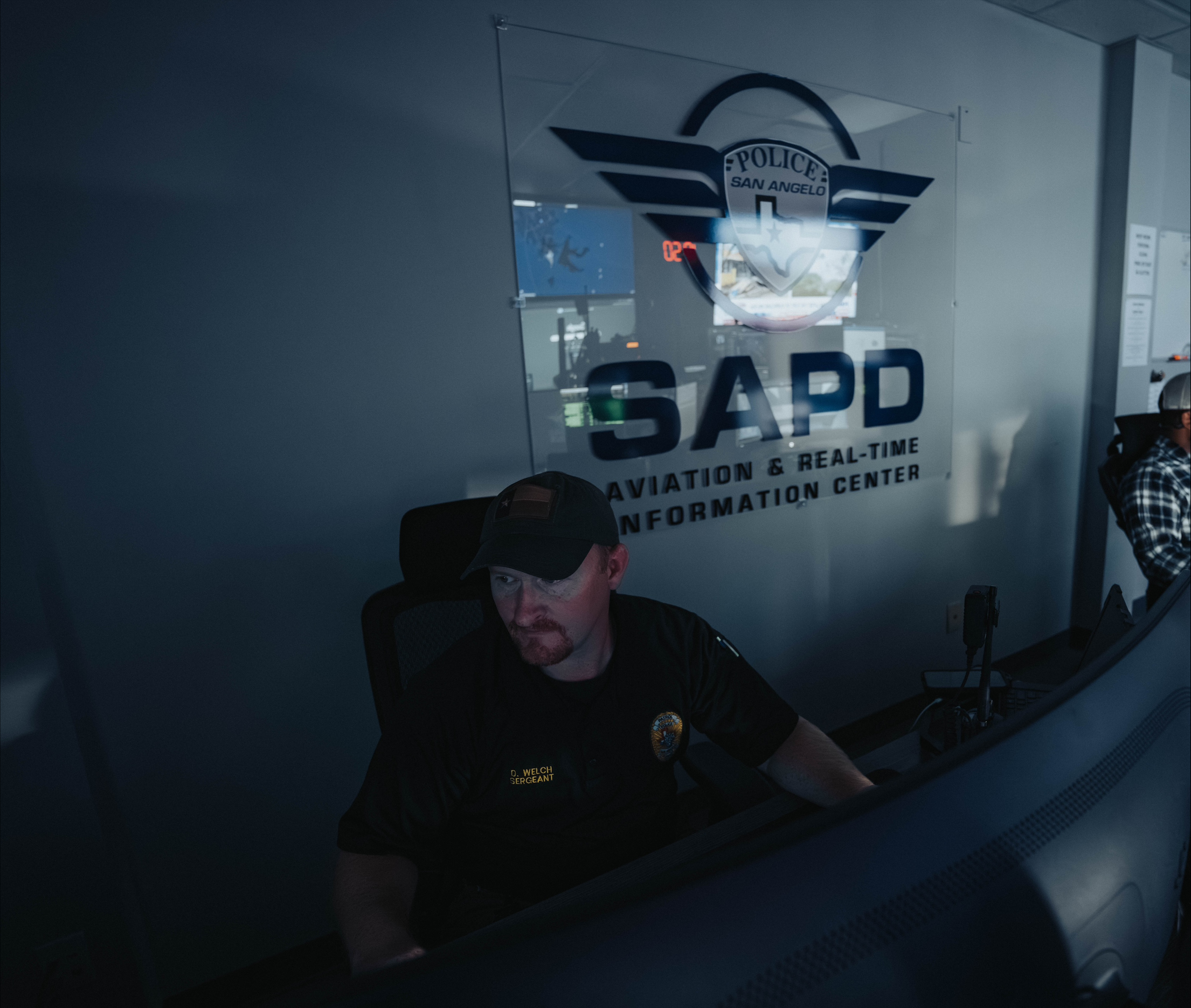
As we rounded a corner, we entered a somewhat darkened room illuminated by the glow of numerous large monitors stretching across a wall.
My eyes immediately began scanning the screens.
There were familiar San Angelo streets, recognizable buildings, intersections, and vehicles moving through the city.
These were live camera feeds.
The low hum of police radio communications filled the room as officers worked at their stations, observing monitors, reviewing information, and switching between camera views and incident-related displays.
It felt like stepping into the nerve center of a much larger operation.
Sergeant Welch began explaining how ARTIC brings together different technologies and information sources to give officers greater situational awareness.
We learned about the department's ability to access various camera systems, including city-operated cameras and video associated with officers in the field.
But one particular capability captured my attention.
The drones.
Drones Without a Pilot Standing Outside
Going into the tour, I had a fairly traditional picture of what a police drone operation would look like.
I imagined an officer walking outside, placing a drone on the ground, picking up a handheld controller, and launching it into the air.
That wasn't what we saw.
Sergeant Welch explained that SAPD has four drones positioned at strategically selected locations around San Angelo.
Each drone sits inside a weather-resistant docking station that provides protection and charging capabilities.
When needed, personnel can remotely activate a drone, open its enclosure, launch it, and direct it toward a destination.
And they can do all of this from inside the ARTIC control room.
The drones transmit live video back to the facility, giving officers an aerial view of a location or developing situation.
During our visit, a request for a drone flight came in.
One of the wall monitors changed, and suddenly we were looking through the drone's camera as it hovered above a parking lot.
This was no longer a theoretical demonstration. We were watching the technology in operation.
Later, Welch played a recording of a previous flight to demonstrate how the system could be used during an actual response. Identifying information was obscured during the presentation.
As someone with an interest in drones, networking, and remote systems, I found the technical capabilities fascinating.
But beyond the technology itself, I could see the operational value of giving responding officers an additional perspective before they arrive at a scene.
Imagine officers responding to a potentially dangerous situation with the ability to observe the location from above before approaching it.
That additional awareness could help officers make better-informed decisions, potentially reducing risks to themselves and the public.
Of course, that same capability raises important questions about when drones are deployed, what they record, and how long that information is retained.
Those questions are worth asking, too.
Flock Cameras: What They Actually Do
Our conversation eventually moved to another technology that has generated considerable public discussion: Flock cameras.
These cameras are part of an automated license plate recognition system, commonly referred to as ALPR.
One of the first things we learned was that the Flock cameras discussed during our visit were not conventional live-streaming surveillance cameras.
Unlike the city camera feeds we had just observed on the monitor wall, there was no continuous live video feed available from those Flock license plate readers.
Instead, the cameras capture images of passing vehicles and their license plates, allowing authorized personnel to search recorded information when investigating incidents.
Sergeant Welch explained that San Angelo has 30 Flock cameras positioned throughout the city.
According to the information shared during our visit, the department's retention period for this data is 15 days.
We also discussed access controls.
Officers do not simply browse the information without leaving a record. Access to the system is associated with individual user accounts, and searches or access activity can be logged for accountability.
From an information security perspective, this was an important part of the conversation.
Technology that collects potentially sensitive information should have controls governing who can access it, how it is used, and whether that activity can be reviewed.
Those controls matter just as much as the capabilities of the cameras themselves.
Why Are the Cameras Located Where They Are?
Another question we explored was the placement of the cameras.
What exactly does strategically positioned mean?
According to the explanation we received, camera locations were selected with crime patterns and investigative needs in mind.
Some are positioned in areas with higher crime activity, while others are located along routes or at points considered relevant to criminal activity and investigations.
In other words, the department described a placement strategy based on law enforcement needs rather than simply distributing cameras evenly across the city.
But Are These Cameras Actually Helping Solve Crimes?
This was perhaps one of the most important questions raised during our visit.
It is one thing to demonstrate impressive technology. It is another to show that the technology is producing meaningful results.
Sergeant Welch directed our attention to a publicly accessible Flock Safety transparency website containing examples of how the system has assisted the San Angelo Police Department.
The examples were particularly interesting because they demonstrated that the technology was being used for more than simply identifying stolen vehicles.
Among the publicly reported cases:
July 2026: ARTIC received a Flock alert involving a missing juvenile and a stolen vehicle. A Drone as First Responder (DFR) pilot launched a drone toward the area where the vehicle had been detected. The pilot located the vehicle from the air and observed the missing juvenile exiting it. Officers were directed to the location, the vehicle was recovered, and the juvenile was taken into custody.
June 2026: The Traffic Division identified three suspect vehicles involved in three separate hit-and-run incidents using Flock license plate recognition.
May 2026: Officers received an alert about a stolen vehicle on the north side of San Angelo. The vehicle was recovered, and a suspect was taken into custody.
May 2026: ARTIC intelligence specialists used a retrospective search of the Flock database to identify a vehicle connected to a burglary investigation.
April 2026: The Traffic Division identified four suspect vehicles involved in four separate hit-and-run incidents.
Another May incident involved identifying a suspect vehicle connected to an additional hit-and-run.
These examples are documented on the San Angelo Police Department's public Flock Safety transparency page.
The July incident was particularly interesting to me because it illustrated how two technologies we had just learned about could work together.
A license plate reader detected a vehicle of interest. That information helped direct a drone to the area. The drone provided an aerial perspective, allowing officers to locate the vehicle and the missing juvenile.
This was a practical example of technology supporting a coordinated law enforcement response.
The published examples do not establish how many crimes the system has prevented or its overall effectiveness. But they do offer documented cases in which SAPD reports that the technology assisted investigations and recoveries.
And that is useful information for the public to have.
What About Privacy?
Throughout the visit, I remained interested in the distinction between what these systems are technically capable of doing and how the department uses them.
For example, I asked whether the Flock cameras collected other types of electronic information, such as identifiers associated with mobile phones.
The answer we received was no.
Sergeant Welch described the system as capturing vehicle images and license plate information, not mobile phone identifiers.
We also discussed whether damaging, defacing, or removing a Flock camera would constitute a crime.
The answer was yes.
These may seem like straightforward questions, but they are important ones.
Public discussions about surveillance technology can quickly become emotional, particularly when people are uncertain about what information is being collected or how it might be used.
That uncertainty deserves answers rather than dismissal.
At the same time, understanding the actual capabilities and limitations of a system helps distinguish legitimate concerns from assumptions.
Technology, Trust, and Accountability
I walked away from ARTIC impressed by the technology, but also thinking about something larger.
There is an important distinction between a technology's capabilities and the policies governing its use.
A license plate reader can help investigators identify a vehicle. A drone can provide responding officers with valuable situational awareness. A real-time operations center can bring together information that might otherwise remain scattered across different systems.
Those are meaningful capabilities.
But none of them eliminates the need for transparency, oversight, accountability, and public discussion.
As someone who works in cybersecurity, I understand that trust should never depend solely on assurances that a system is being used responsibly.
Trust should be supported by appropriate safeguards, clear policies, access controls, and mechanisms for accountability.
Our visit provided a valuable look at some of the department's operational practices. It was not, however, an independent audit of the department's systems, policies, or safeguards.
I think that distinction matters.
The public should be able to appreciate technology that helps protect the community while still asking reasonable questions about how it is governed.
Those positions are not mutually exclusive.
A Response from SAPD: Transparency, Privacy, and Accountability
The conversation about technology, privacy, and accountability did not end when our tour concluded. Following the visit, Sergeant Welch offered additional perspective on how the department approaches these responsibilities.
He emphasized that the department recognizes the concerns these technologies can raise and welcomes respectful conversations with the community.
Regarding the ARTIC facility itself, Sergeant Welch explained:
"Our intent has never been to conceal the use of this technology. Rather, we have chosen not to overtly publicize the building itself for security reasons."
He also stressed that technology is intended to support officers, not replace their professional judgment or human interaction.
On the subject of oversight, Sergeant Welch stated that ARTIC systems are regularly audited by police command staff and himself in his role as systems administrator. He reported that, to date, those reviews have identified no instances of employee abuse.
He further emphasized his personal commitment to constitutional protections, lawful operations, and citizens' privacy rights, stating that misuse of the technology would be addressed appropriately.
Sergeant Welch also drew a distinction between the responsible use of technology and its potential misuse. In his view, the lawful use of these systems, with appropriate oversight, can support criminal investigations and public safety without inherently constituting an abuse of authority.
He closed by emphasizing that public trust depends on transparency, accountability, and open communication.
A Different Perspective Behind an Ordinary Door
I keep thinking back to that unassuming building.
From the outside, there was little to indicate what was happening within. No elaborate architecture, no prominent signage, and nothing particularly remarkable about its appearance.
Yet inside was a room filled with technology connecting cameras, drones, communications, and information to support law enforcement operations across San Angelo.
It was a reminder that some of the most interesting applications of technology in our community are not necessarily the most visible.
I appreciate Assistant Chief Adam Scott for opening the door to this opportunity and Sergeant Welch for taking the time to walk us through the facility, explain the technology, and answer our questions.
I also appreciate the San Angelo Police Department's willingness to engage with members of the local technology community.
Through the Concho Valley Technology Alliance, we often talk about connecting people with technology, education, and opportunities to better understand the systems shaping our world.
This visit was a good example of that mission in action.
I entered the facility curious about the technology.
I left with a better understanding of how it is being used in San Angelo, a greater appreciation for its potential benefits, and a continued belief that informed public conversations are far more valuable than assumptions made from a distance.
We don't have to choose between supporting public safety and asking serious questions about privacy. A responsible community should be willing to do both.
— Gabe Menchaca
Written by Gabe Menchaca, board member of the Concho Valley Technology Alliance. The observations and opinions expressed are those of the author.