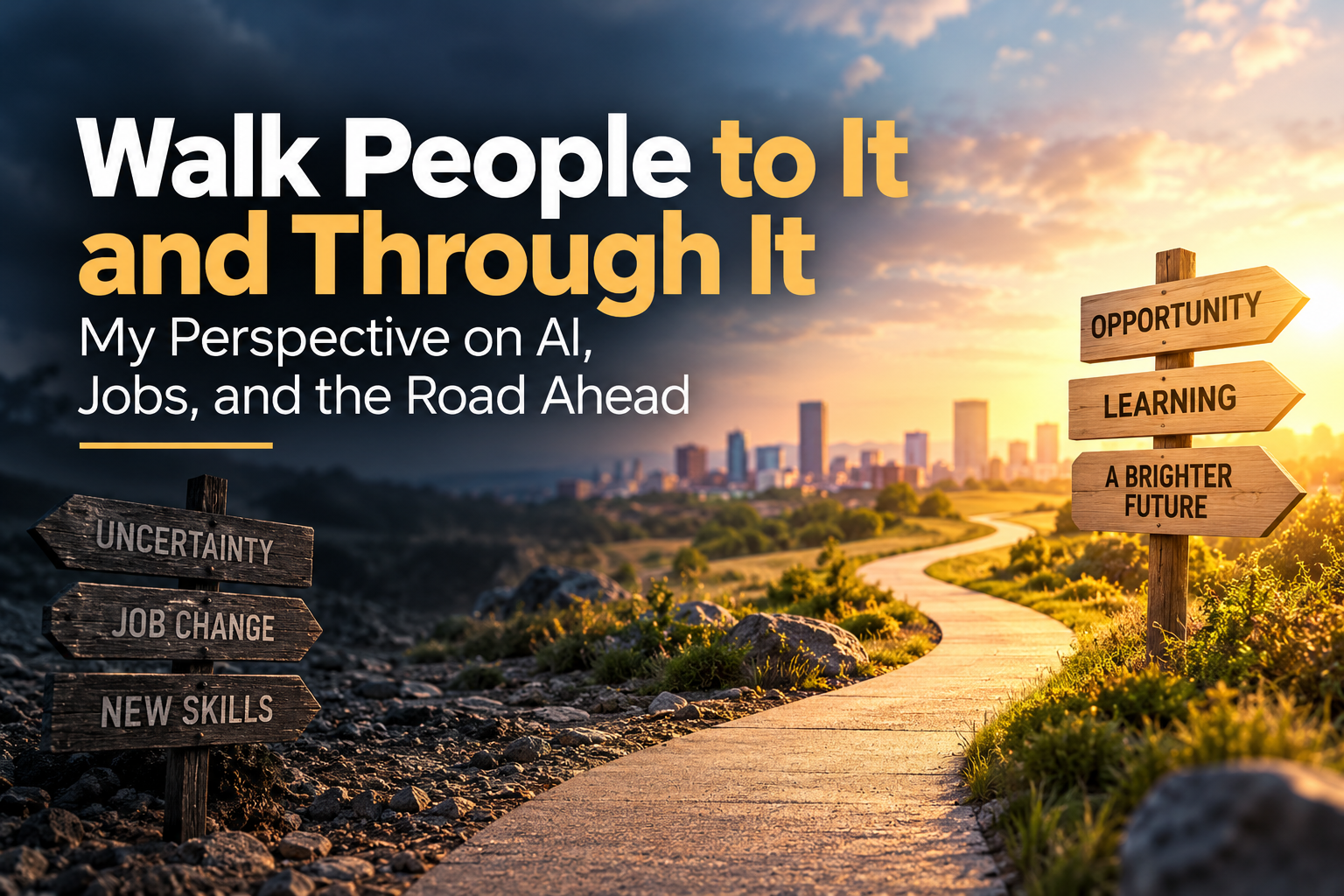
Walk People to It and Through It: My Perspective on AI, Jobs, and the Road Ahead Artificial intelligence is going to change the way we work. I believe it will eliminate some jobs, create others, and fundamentally reshape many more. The question isn't whether change is coming. It's how we help people navigate it.
I've spent much of my professional life working in technology. I've watched technologies emerge, mature, and eventually become part of our everyday lives. Some arrived with great excitement. Others were met with skepticism, resistance, and sometimes genuine fear.
Artificial intelligence is different in its speed, accessibility, and potential impact. But I believe there are lessons from previous technological transitions that can help us navigate this one.
Let me start with something I believe strongly.
AI is going to replace jobs.
Not just individual tasks. Not just repetitive administrative work. I believe entire roles and occupations will change significantly, and some will disappear.
I don't say that to frighten anyone. I say it because I believe we need to have an honest conversation about what's happening.
I also believe that society will adapt.
That adaptation, however, isn't going to happen without some struggle. The Messy Middle I suspect we're entering what might be described as a messy period of technological transition.
Businesses are experimenting with AI. Employees are wondering what it means for their careers. Educators are reconsidering how they prepare students. Community leaders are trying to understand the economic implications.
Meanwhile, the technology continues advancing.
Some organizations will adopt AI thoughtfully. Others will rush into it without fully understanding the consequences. Some workers will find tremendous opportunities, while others may discover that skills they've spent years developing are becoming less valuable in the marketplace.
I don't believe we should dismiss those concerns.
In fact, I think dismissing them is one of the worst things we can do.
I've encountered people who are genuinely frightened about what AI means for their future. I've also encountered fears that I believe are exaggerated, based on misinformation, or driven by misunderstandings about what the technology can actually do.
But there are also legitimate concerns.
Job displacement is legitimate. Privacy is legitimate. Security is legitimate. The concentration of economic power and the possibility of leaving entire groups of people behind are legitimate concerns.
We should be willing to acknowledge all of them.
Recognizing legitimate risks doesn't make someone anti-technology. And supporting technological progress doesn't mean ignoring the people who may be negatively affected by it.
I believe we can do both. Walk People to It and Through It There's a phrase I've increasingly come to appreciate when thinking about technology adoption:
Walk people to it and through it.
It's a simple idea, but I think it captures something missing from many conversations about artificial intelligence.
We spend a tremendous amount of time telling people what AI can do.
We talk about productivity gains, automation, intelligent agents, and how AI will transform entire industries.
We demonstrate impressive applications and celebrate how quickly things can now be accomplished.
But how often do we sit down with someone who has never used AI and help them solve an actual problem?
How often do we ask what challenges they face in their daily work and then show them, step by step, how AI might help?
That's where I believe meaningful adoption begins.
Not with another presentation about the future.
Not with insisting that everyone needs to embrace AI immediately.
And certainly not by suggesting that AI is the solution to every problem.
It begins with understanding someone's needs.
Find a problem. Explore whether AI can help solve it. Show the person how it works. Let them try it themselves.
And perhaps most importantly, stay with them long enough for that initial curiosity to develop into confidence.
Don't just tell people what AI can do. Help them experience what it can do.
I also believe it's important to recognize that people are starting from different places.
Some have never used AI. Others use it occasionally without fully understanding its capabilities. Still others are already building applications, automating processes, and experimenting with increasingly sophisticated tools.
Helping people navigate AI means recognizing those differences and meeting them where they are. Bringing That Philosophy Into Our Community Over the past year, I've had opportunities through the Concho Valley Tech Alliance (CVTA) to help organize educational events focused on making artificial intelligence more accessible to our community.
These experiences have helped shape my thinking about what meaningful AI education and adoption should look like.
In July, we hosted Harley Chrane for a presentation titled Artificial Intelligence: On and Off the Clock.
We had approximately 45 attendees, representing different backgrounds, professions, and levels of experience.
One of my more interesting observations during the event was that most of the people attending were already using AI in some capacity.
They weren't necessarily beginners. Many had already incorporated AI into their professional or personal lives.
Yet afterward, several expressed that they had learned something they hadn't previously considered.
Some left with the intention of exploring Harley's concept of using AI as a second brain, something that could help them organize information, develop ideas, and approach problems differently.
That stuck with me.
It reinforced something I believe is important: AI adoption isn't simply about getting people to use AI for the first time. It's also about helping those already using it recognize what else might be possible.
Someone might use AI regularly to draft emails or answer questions without realizing how it could help them think through a complicated decision, organize a project, or develop a new idea.
Sometimes a relatively simple demonstration can change how someone approaches a technology they've already been using for months.
In September, CVTA partnered with the Angelo State University Small Business Development Center to host a workshop led by Gin J., focused on building AI agents with Microsoft Copilot.
This event offered a different learning experience.
What stood out to me wasn't simply the technology being demonstrated.
It was the interaction among the people in the room.
There was an open dialogue between Gin and the audience, but also between the attendees themselves.
People were sharing ideas, discussing what they were building, asking questions, and learning from one another.
There was an energy in that room that I found particularly encouraging.
It wasn't just a group of people sitting quietly while someone explained a new technology.
It felt more like a community of people exploring possibilities together.
And I think there's something valuable in that.
When people begin sharing what they're building, what they're learning, and even what they're struggling with, technology becomes less of an abstract concept and more of a shared experience.
Someone else's idea might inspire a solution you hadn't considered. A question from another participant might reveal something you didn't know. And seeing someone with a similar background successfully use AI can make the technology feel considerably more approachable.
These two events reinforced different lessons for me.
Harley's presentation reminded me that even people familiar with AI can benefit from exposure to new ways of thinking about it.
Gin's workshop reminded me that some of the most valuable learning happens when people have opportunities to interact, experiment, and exchange ideas.
Neither event was intended to make anyone an expert.
But both created opportunities for people to expand their understanding.
And perhaps that's exactly what we should be doing more of.
I've come to believe that some of the most meaningful progress in AI adoption doesn't happen when someone demonstrates what the technology can do. It happens when people begin imagining, together, what they can do with it. The Difference Between Exposure and Adoption One observation I've made is that exposing people to technology isn't necessarily the same as helping them adopt it.
Someone can attend a presentation, be impressed by a demonstration, and walk away excited about the possibilities.
But what happens the next morning?
Do they actually use what they've learned?
Do they know where to begin?
Can they identify a problem in their own work or personal life where AI might provide value?
Or does the excitement fade because the connection between the demonstration and their everyday reality was never established?
These are questions I've been asking myself as I think about future community events.
I believe we need to move beyond simply introducing AI and begin helping people integrate it into their lives in practical, responsible ways.
That means smaller, more focused learning opportunities. Real-world problems. Hands-on experiences. And perhaps most importantly, an environment where people feel comfortable admitting what they don't understand.
It also means recognizing that education and adoption aren't necessarily a straight line from beginner to expert.
Some people need an introduction to the technology.
Others are already using AI but haven't discovered its broader capabilities.
Still others are experimenting, building things, and looking for opportunities to exchange ideas with people doing similar work.
Each group can benefit from a different approach.
And there's value in bringing those groups together.
We shouldn't underestimate how intimidating technology can be to someone who hasn't spent their career working with it.
Something that seems obvious to a technology professional may be completely unfamiliar to someone encountering it for the first time.
That doesn't mean the person lacks ability or intelligence.
It simply means they're starting from a different place.
Our responsibility should be to meet them there.
I also think we should be careful about measuring success simply by how many people attend an event or how impressed they are by a demonstration.
The more meaningful question might be what happens afterward.
Did someone gain the confidence to try something new? Did they discover a practical application? Did they make a connection with someone who could help them continue learning?
Those outcomes may be harder to measure, but I suspect they're considerably more important. Preparing for Jobs That Will Change I believe one of the most important conversations we should be having about AI concerns workforce preparation.
For years, we've encouraged people to develop technical skills, pursue certifications, obtain degrees, and continue their education.
I still believe those things matter.
But I also think we need to recognize that the useful life of certain skills may become shorter as AI capabilities improve.
Tasks that once required specialized knowledge or considerable time can increasingly be completed with assistance from AI.
I've experienced this myself.
I've used AI to help develop software, work through technical challenges, and explore ideas that previously would have required substantially more time or outside assistance.
The experience has been both exciting and humbling.
It's shown me how much more an individual can accomplish with these tools.
It's also made me think seriously about what happens when organizations begin applying those same capabilities across their workforce.
Some jobs will become more productive.
Some will evolve into entirely different roles.
And some will no longer require the same number of people.
We should be honest about that possibility.
However, I don't believe the appropriate response is to tell people that their careers are doomed.
Nor do I think it's helpful to promise that AI will automatically create enough new jobs to replace every position it eliminates.
We simply don't know how evenly the benefits and disruptions will be distributed.
What we can do is prepare.
Workers can begin developing familiarity with AI tools relevant to their professions. Employers can invest in retraining rather than viewing automation exclusively as an opportunity to reduce headcount. Educational institutions can reconsider how they prepare students for a changing workplace.
And communities can create opportunities for people to learn without requiring them to enroll in an expensive program or pursue an entirely new career.
I believe that last point is particularly important for communities like San Angelo.
We don't have to wait for large technology companies or government institutions to lead every aspect of this transition.
We can begin helping one another right here.
I also hope people recognize that preparation doesn't necessarily mean abandoning the skills and experience they've spent years developing.
In many cases, those skills may become even more valuable when combined with an understanding of how to use AI effectively.
Someone who understands their profession, recognizes problems, exercises good judgment, and knows how to apply AI appropriately may be better positioned than someone who simply knows how to operate an AI tool.
AI can assist with the work, but understanding the work still matters.
And I believe that's an important message for people concerned about their future.
You may not be able to prevent every change AI brings to your profession, but you can take steps today to better prepare yourself for those changes. Adoption Requires Responsibility My enthusiasm for artificial intelligence doesn't mean I believe it should be adopted without appropriate safeguards.
Quite the opposite.
Working in information security has made me particularly aware of the risks associated with introducing new technology into an organization.
AI systems can produce inaccurate information. They can expose sensitive data when used carelessly. AI-generated software can contain vulnerabilities. And automating a flawed process doesn't necessarily make that process better.
Sometimes it simply allows us to make mistakes faster.
Responsible adoption requires understanding these limitations.
It requires governance, security awareness, human oversight, and a willingness to question whether AI is actually the right solution for a particular problem.
I think this is another area where we sometimes fail people.
We demonstrate the impressive capabilities of AI without spending enough time explaining what can go wrong.
If we're going to encourage people to use these tools, we should also help them understand how to use them responsibly.
That is part of walking people through it.
And sometimes, after understanding the capabilities and risks, someone may decide that AI isn't appropriate for their particular situation.
That's okay too.
The goal shouldn't simply be to produce more AI users. It should be to help people make informed decisions about a technology that will increasingly affect their lives. Progress Doesn't Have to Leave Everyone Behind I don't believe artificial intelligence is a passing trend.
I believe it represents a fundamental change in how we work, learn, create, and solve problems.
And I believe that change is largely inevitable.
But inevitable change doesn't mean we're powerless to influence how it unfolds.
We can choose whether to approach AI adoption thoughtfully or recklessly.
We can choose whether to invest in helping people develop new skills or simply expect them to figure things out on their own.
We can choose whether to acknowledge legitimate fears or dismiss them as resistance to progress.
I suspect the coming years will be difficult for some people.
There will be mistakes. There will be organizations that make poor decisions. There will be workers who struggle to adapt, and there may be communities that experience significant economic disruption.
I don't want to minimize any of that.
But I also believe we will learn.
Organizations will develop better practices. Educational systems will evolve. New opportunities will emerge, and our understanding of how to work alongside AI will improve.
I believe the transition can become less disruptive over time, particularly if we're willing to learn from our mistakes and make deliberate efforts to reduce the negative consequences.
That outcome isn't guaranteed.
It will require effort.
And it will require people who are willing to do more than simply advocate for technological advancement.
It will require people willing to help others navigate it. One Person at a Time When I think about the events we've organized through CVTA, the conversations I've had with people in our community, and my own experiments with artificial intelligence, I keep coming back to the same idea.
We don't need everyone to become an AI expert.
But we should want everyone to have an opportunity to understand what's changing and how they might prepare for it.
I know my own contributions are relatively small compared with the scale of the transformation taking place.
I also know that not every event, conversation, or demonstration will produce the results I hope for.
That doesn't discourage me from continuing.
If we can help a business owner discover a more efficient way to manage their work, that's progress.
If we can help an employee recognize how AI might complement their existing skills, that's progress.
If we can help someone who is fearful of AI develop enough understanding to make informed decisions about it, that's progress too.
And if we can help people recognize the limitations and risks of AI while still exploring its potential, perhaps that's even more valuable.
I think back to the people who attended Harley's presentation and discovered new ways to use a technology they were already familiar with.
I think about the conversations during Gin's workshop, where people weren't simply learning from a presenter but were exchanging ideas and inspiring one another.
Those experiences remind me that meaningful change doesn't always begin with a major initiative or a sweeping policy decision.
Sometimes it begins with a conversation, a demonstration, or someone showing another person how to solve a problem.
I believe AI will change the workforce. I believe some jobs will disappear. I believe the transition will be messy.
But I also believe we have an opportunity, and perhaps a responsibility, to make that transition easier for the people around us.
We won't accomplish that by simply telling everyone how amazing artificial intelligence is.
We'll accomplish it by listening, teaching, demonstrating, and helping people develop the confidence to participate in a changing world.
Walk people to it. And then walk them through it.
That's the approach I believe in.
And it's the work I intend to keep doing.